

Coast FIRE Number by Age: Complete Reference Chart

Your Coast FIRE Number Depends on One Thing: Time
The single biggest factor in your Coast FIRE number isn't your income, your savings rate, or even which index funds you pick — it's how many years you have until retirement.
More years means more time for compound growth, which means a dramatically lower Coast FIRE target today.
A 25-year-old needs far less invested than a 45-year-old because they have 20 extra years of compounding. That's not just a small difference — it can be $200,000+ less for the exact same retirement lifestyle.
Below, we break down the exact Coast FIRE numbers by age, using multiple spending levels and market assumptions. All numbers use the standard 4% rule and are adjusted for inflation (real returns).
Coast FIRE Numbers for $40,000/Year Retirement Expenses
Retirement target: $1,000,000 (25× annual expenses)
Assumptions: 7% nominal return, 3% inflation (3.88% real return), retirement at age 65.
| Current Age | Years to Grow | Coast FIRE Number | Monthly Savings to Get There (from age 22) |
|---|---|---|---|
| 25 | 40 | $216,245 | ~$2,200/mo for 3 years |
| 30 | 35 | $261,413 | ~$1,800/mo for 8 years |
| 35 | 30 | $316,017 | ~$1,400/mo for 13 years |
| 40 | 25 | $382,009 | ~$1,200/mo for 18 years |
| 45 | 20 | $461,758 | ~$1,100/mo for 23 years |
| 50 | 15 | $558,110 | ~$1,050/mo for 28 years |
| 55 | 10 | $674,646 | ~$1,000/mo for 33 years |
What the Numbers Tell You
Every 5 years of delay adds roughly $50,000–$120,000 to your Coast FIRE target. The compounding curve isn't linear — it accelerates. This is why financial advisors constantly emphasize starting early.
Coast FIRE Numbers for $50,000/Year Retirement Expenses
Retirement target: $1,250,000
| Current Age | Years to Grow | Coast FIRE Number |
|---|---|---|
| 25 | 40 | $270,306 |
| 30 | 35 | $326,766 |
| 35 | 30 | $395,021 |
| 40 | 25 | $477,511 |
| 45 | 20 | $577,198 |
| 50 | 15 | $697,638 |
| 55 | 10 | $843,308 |
At $50K/year spending, your targets are 25% higher across the board. For most people in high cost-of-living areas, this is a more realistic spending estimate.
Coast FIRE Numbers for $60,000/Year Retirement Expenses
Retirement target: $1,500,000
| Current Age | Years to Grow | Coast FIRE Number |
|---|---|---|
| 25 | 40 | $324,367 |
| 30 | 35 | $392,119 |
| 35 | 30 | $474,025 |
| 40 | 25 | $573,013 |
| 45 | 20 | $692,637 |
| 50 | 15 | $837,165 |
| 55 | 10 | $1,011,969 |
At $60K/year, a 55-year-old's Coast FIRE number exceeds $1M — meaning Coast FIRE becomes essentially the same as full FIRE at this point. This highlights why Coast FIRE is most powerful for younger savers.
The Visual: How Age Affects Your Target

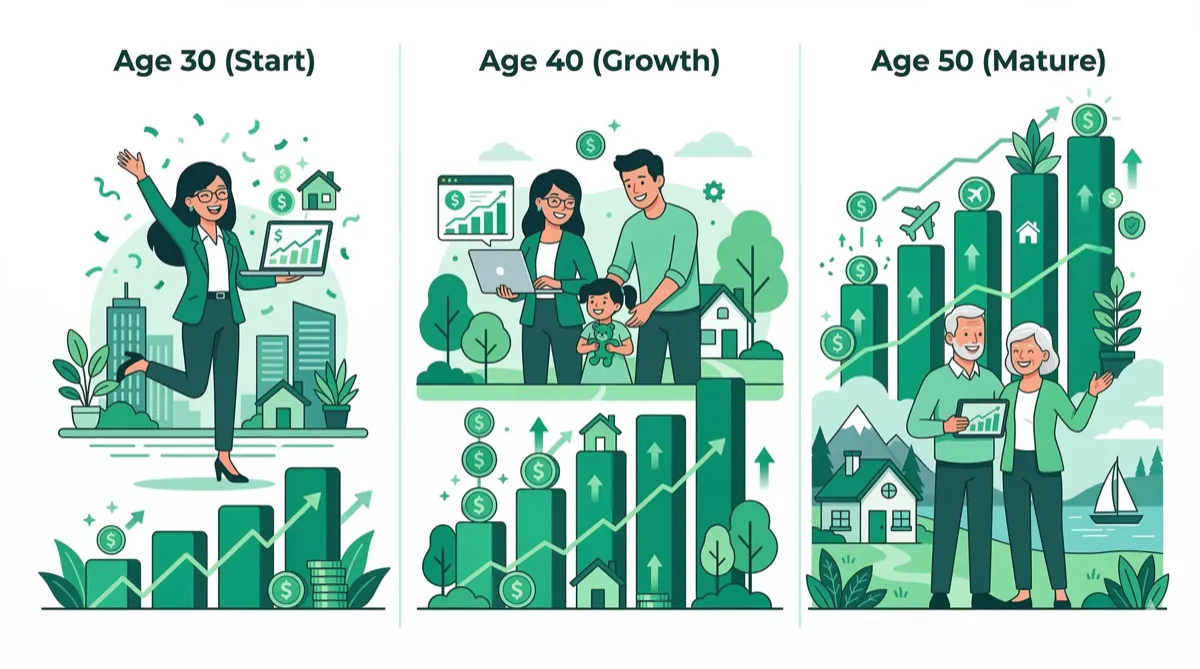
The chart above illustrates one of the most important concepts in personal finance: time is more powerful than money.
Consider this:
- A 25-year-old with $216K invested can coast to $1M by 65. That's 40 years of compounding doing all the work.
- A 45-year-old needs $462K for the same result. That's more than double — because they only have 20 years of compounding.
- A 55-year-old needs $675K. At that point, time has so little runway that compound growth barely helps.
The takeaway: Every year you delay costs you more than the last. If you're in your 20s or early 30s, the math is overwhelmingly in your favor.
Coast FIRE by Life Stage
Coast FIRE by 30 — "The Early Achiever"
Target ($40K expenses): ~$261K invested
To reach this starting from zero at age 22:
- Save approximately $2,700/month for 8 years (assuming 7% returns)
- That's about $32,400/year — aggressive, but achievable for high-income earners in tech, finance, medicine, or engineering
- Many people also get a head start from employer 401(k) matching
Who reaches this? Software engineers, consultants, medical professionals, or anyone earning $80K+ who lives well below their means. Also common among people who received a financial head start (inheritance, no student loans).
What changes after? Everything. At 30, you have 35+ working years ahead of you — but none of them have to be about retirement savings. Switch to a nonprofit. Start a business. Go part-time. Travel for a year. Your retirement is already handled.
Coast FIRE by 35 — "The Strategic Saver"
Target ($40K expenses): ~$316K invested
- Starting at 22: $1,700/month for 13 years
- Starting at 25: $2,100/month for 10 years
- Very achievable for dual-income households
Who reaches this? Most diligent savers with median-to-good income who started in their early-to-mid 20s. Especially common among people who maxed out 401(k) contributions from the start.
Coast FIRE by 40 — "The Mainstream Milestone"
Target ($40K expenses): ~$382K invested
- Starting at 22: $1,300/month for 18 years
- Starting at 30: $2,400/month for 10 years
- The most achievable Coast FIRE age for average earners
Who reaches this? A surprisingly large number of people who have been contributing to retirement accounts consistently for 15+ years. If you've been putting $500/month into a 401(k) since age 25 with employer match, you're likely close to or past this number.
Coast FIRE by 50 — "The Natural Coaster"
Target ($40K expenses): ~$558K invested
Many people reach this without even trying. If you've been contributing to a 401(k) for 25+ years with reasonable employer matching and market returns, your accounts may have crossed this line organically. Check your balances — you might already be Coast FIRE.
Conservative Scenario: What If Markets Underperform?
The tables above use "moderate" assumptions (7% return, 3% inflation = 3.88% real return). But what if markets don't deliver? Here's the conservative scenario:
Conservative assumptions: 5% nominal return, 4% inflation (0.96% real return)
| Current Age | $40K Expenses | $50K Expenses | $60K Expenses |
|---|---|---|---|
| 25 | $670,468 | $838,085 | $1,005,702 |
| 30 | $703,561 | $879,451 | $1,055,341 |
| 35 | $738,292 | $922,865 | $1,107,438 |
| 40 | $774,739 | $968,423 | $1,162,108 |
| 45 | $812,979 | $1,016,224 | $1,219,469 |
Under conservative assumptions, Coast FIRE numbers are 2–3x higher. This is because the real return is only ~1%, so compound growth barely outpaces inflation.
Which Scenario Should You Use?
| If you are... | Use this scenario |
|---|---|
| Naturally cautious, close to retirement | Conservative (5%/4%) |
| Balanced investor, long time horizon | Moderate (7%/3%) |
| Young, high risk tolerance, all-equity portfolio | Aggressive (10%/2%) |
For most people in their 20s–30s with a diversified stock portfolio, the moderate scenario is historically well-supported. Use conservative numbers for a stress-tested plan.
Want to try different scenarios? Use our calculator with scenario switching — toggle between all three with one click.
Aggressive Scenario: What If Markets Outperform?
Aggressive assumptions: 10% nominal return, 2% inflation (7.84% real return)
| Current Age | $40K Expenses | $50K Expenses | $60K Expenses |
|---|---|---|---|
| 25 | $49,615 | $62,019 | $74,422 |
| 30 | $72,378 | $90,472 | $108,567 |
| 35 | $105,597 | $131,996 | $158,395 |
| 40 | $154,024 | $192,530 | $231,036 |
| 45 | $224,689 | $280,861 | $337,034 |
Under aggressive assumptions, the numbers look almost too good to be true — and they might be. While the S&P 500 has delivered ~10% nominal returns historically, there have been extended periods (2000–2012) where returns were flat. Don't use aggressive numbers as your primary plan.
How to Use These Charts
- Find your age row in the relevant expense table
- Pick your expected retirement expenses (in today's dollars — not inflated future dollars)
- Compare to your current investment portfolio to see your progress
- Check all three scenarios (conservative, moderate, aggressive) to understand your range
- Use the Reverse Calculator to find exactly how much to save each month to reach your number
A Practical Approach
- Primary target: Use the moderate scenario as your goal
- Stress test: Make sure you're comfortable with the conservative number too
- Celebrate: If you hit the aggressive scenario number, you're in great shape — anything above that is bonus
- Revisit annually: Recalculate each year as your portfolio and plans change
Frequently Asked Questions
Do these numbers include Social Security?
No. These calculations assume your investments must cover 100% of retirement expenses. Social Security benefits would reduce your actual need, making these numbers more conservative. Think of Social Security as a bonus safety margin.
What about employer 401(k) match?
Employer matching is essentially free money added to your portfolio. It accelerates your path to Coast FIRE significantly. If your employer matches 4% of your salary, you're effectively saving more than your take-home contribution.
What if I want to retire at 60 instead of 65?
Earlier retirement = fewer years of growth = higher Coast FIRE number. A 30-year-old targeting retirement at 60 (30 years of growth) needs $316,017 instead of $261,413 for the same lifestyle. Use our calculator to adjust the retirement age.
What if my expenses will be higher in retirement?
Plan for the higher number. If you think you'll spend $60K instead of $40K, use the $60K table. It's better to overshoot your Coast FIRE number than undershoot it.
Want personalized numbers with your exact inputs? Try the interactive calculator — it lets you adjust every parameter and see real-time results.
Numbers are for educational reference only. Actual results depend on market performance, personal circumstances, and many other factors. Consider consulting a financial advisor for personalized guidance.