

Coast FIRE vs Lean, Barista & Fat FIRE: Full Comparison
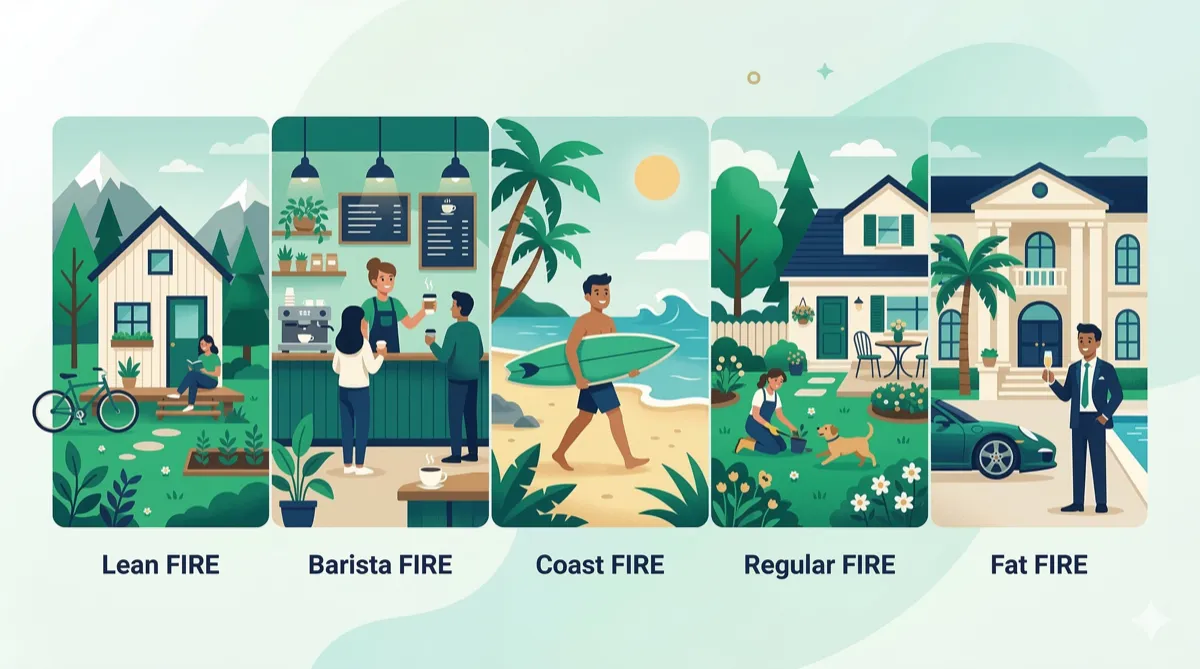
The FIRE Movement Isn't One-Size-Fits-All
The Financial Independence, Retire Early (FIRE) movement has evolved far beyond its original premise of "save 25x expenses and quit your job." Today, there are multiple distinct strategies — each with different savings targets, lifestyle tradeoffs, and timelines.
Understanding these variations is crucial because choosing the wrong FIRE strategy can lead to burnout, disappointment, or unnecessary sacrifice. The right approach depends on your income, age, risk tolerance, and what "freedom" means to you personally.
Quick Comparison Table
| Strategy | Savings Target | Can You Stop Working? | Lifestyle After | Time to Achieve | Best For |
|---|---|---|---|---|---|
| Coast FIRE | $200K–$400K | No — cover current expenses | Flexible/part-time work | 5–15 years | Career changers, young savers |
| Barista FIRE | Varies | Part-time only | Part-time + investments | 8–18 years | Semi-retirees |
| Lean FIRE | $625K–$1M | Yes — frugal | Minimalist retirement | 10–20 years | Frugal-minded |
| Regular FIRE | $1.25M–$2M | Yes | Comfortable retirement | 12–25 years | Balanced approach |
| Fat FIRE | $2.5M–$5M+ | Yes — no compromises | Luxury retirement | 15–30+ years | High earners |

Coast FIRE — "Front-Load and Relax"
The idea: Save aggressively in your 20s–30s until compound growth can carry your investments to your retirement target. After that, you only need to earn enough for daily living expenses.
How It Works
- Calculate your retirement target (annual expenses × 25)
- Discount it back to today using real returns
- Save until your portfolio reaches that discounted amount
- Stop saving for retirement — work only for current expenses
The Numbers
| Retirement Spending | Coast FIRE Target (age 30) | Coast FIRE Target (age 40) |
|---|---|---|
| $40,000/yr | $261,413 | $382,009 |
| $50,000/yr | $326,766 | $477,511 |
| $60,000/yr | $392,119 | $573,013 |
Pros
- Most achievable FIRE variant — targets are 1/4 to 1/3 of traditional FIRE
- Eliminates retirement savings pressure — the psychological relief is immediate
- Maximum career flexibility — pursue passion over paycheck
- No lifestyle sacrifice in retirement — you're still planning for comfortable spending
- Reversible — you can always keep saving toward full FIRE if you want
Cons
- Still need employment income — you're not fully retired
- Healthcare coverage can be a challenge without full-time employment
- Market risk over decades — relies on markets performing reasonably
- Not truly "retired" — some people find this unsatisfying
Who Should Choose Coast FIRE?
- You want career flexibility but don't mind working
- Traditional FIRE feels overwhelmingly far away
- You're in your 20s–30s and can front-load savings
- You prioritize work-life balance over full retirement
- You want the fastest path to financial peace of mind
Calculate your Coast FIRE number →
Barista FIRE — "Part-Time Plus Investments"
The idea: Named after working at Starbucks for health benefits, Barista FIRE means your investments cover most of your retirement needs while a part-time job fills the gap for current expenses — and potentially provides health insurance.
How It Works
- Save enough that investments will grow to cover most retirement needs
- Transition to part-time work that covers current living expenses
- Your part-time income replaces the "you still need to work full-time" aspect of Coast FIRE
- Over time, your investments grow until you can fully retire
The Numbers
Barista FIRE targets are harder to pin down because they depend on your part-time income. The key equation:
Annual Expenses − Part-Time Income = Gap your investments must cover
If you spend $40K/year and earn $20K part-time, your investments only need to generate $20K/year — requiring a portfolio of just $500K (vs. $1M for full FIRE).
Pros
- Lower savings target than traditional FIRE
- Part-time work can provide health insurance — a major benefit in the US
- Maintains social connections and sense of purpose
- Bridge to full retirement — gradual transition instead of abrupt change
- Part-time income provides a safety buffer during market downturns
Cons
- Still requires some employment — not full freedom
- Part-time benefits vary widely by employer and location
- May feel like "not quite retired" — can be psychologically frustrating
- Income uncertainty — part-time work isn't always stable
Who Should Choose Barista FIRE?
- You enjoy working but want less pressure and more flexibility
- Health insurance through part-time work matters to you (especially pre-Medicare in the US)
- Your investments can cover most but not all expenses
- You want a gradual transition to full retirement, not a cliff
- You value social connections that come with a workplace
Simulate your Barista FIRE numbers →
Lean FIRE — "Minimalist Freedom"
The idea: Accumulate 25× minimal annual expenses (typically $25,000–$40,000/year) so you can fully retire with a frugal, minimalist lifestyle. No work required — but significant lifestyle trade-offs.
How It Works
- Minimize your annual expenses to the bare essentials
- Save 25× that minimal amount
- Retire fully and live on 4% annual withdrawals
- Keep expenses permanently low
The Numbers
| Annual Expenses | FIRE Target | Monthly Savings Needed (15 years, 7% return) |
|---|---|---|
| $25,000/yr | $625,000 | ~$2,100/mo |
| $30,000/yr | $750,000 | ~$2,500/mo |
| $40,000/yr | $1,000,000 | ~$3,300/mo |
Pros
- Full retirement — no work required at all
- Achievable on median income — lower targets than regular FIRE
- Forces clarity on what truly matters to you
- Geographic freedom — can live in low-cost areas or abroad
- Simple lifestyle reduces stress and decision fatigue
Cons
- Very little margin for unexpected expenses (medical emergencies, home repairs)
- Geographic limitations — need low cost-of-living areas
- Lifestyle may feel restrictive long-term, especially if circumstances change
- Healthcare costs can consume a huge portion of a lean budget
- Social isolation risk — limited budget for travel, dining, activities
- No room for error — market downturn + surprise expense = trouble
Who Should Choose Lean FIRE?
- You're naturally frugal and minimalist — this is how you want to live
- You want full retirement as soon as possible, regardless of lifestyle
- You're comfortable with a permanently tight budget
- You live in (or will relocate to) a low cost-of-living area
- You have low or no healthcare costs (covered by partner, national health system, etc.)
Regular FIRE — "The Balanced Path"
The idea: The "standard" FIRE approach — save 25× your comfortable annual expenses ($50,000–$80,000/year), providing a retirement without major sacrifices. This is the approach most commonly discussed in FIRE communities.
How It Works
- Determine your comfortable annual spending in retirement
- Save 25× that amount (following the 4% rule)
- Retire fully with a comfortable lifestyle
- Withdraw 4% annually, adjusted for inflation
The Numbers
| Annual Expenses | FIRE Target | Monthly Savings Needed (15 years, 7% return) |
|---|---|---|
| $50,000/yr | $1,250,000 | ~$4,150/mo |
| $60,000/yr | $1,500,000 | ~$5,000/mo |
| $80,000/yr | $2,000,000 | ~$6,650/mo |
Pros
- Sustainable lifestyle in retirement — no major sacrifices needed
- Reasonable buffer for unexpected costs and market downturns
- Well-researched — backed by the Trinity Study and decades of real-world data
- Most widely documented — huge community of people who've done it
- Flexible — room to increase or decrease spending as needed
Cons
- Requires a high savings rate (40–60% of income) for many years
- Can take 15–20+ years for most income levels
- May require a high income to save enough while maintaining quality of life
- "One more year" syndrome — hard to pull the trigger when you're close
- Can feel like delayed living — you sacrifice a lot of prime years
Who Should Choose Regular FIRE?
- You want a comfortable retirement without compromise
- You can maintain a 40–50% savings rate consistently
- You want the most battle-tested FIRE approach
- You're willing to trade sacrifice now for security later
- You have a high enough income to save $4K+/month
Fat FIRE — "No Compromises"
The idea: Save enough to maintain a luxury or upper-middle-class lifestyle ($100,000–$200,000+ annual spending) without ever working again. This is the "have your cake and eat it too" version of FIRE.
The Numbers
| Annual Expenses | FIRE Target | Monthly Savings Needed (20 years, 7% return) |
|---|---|---|
| $100,000/yr | $2,500,000 | ~$5,000/mo |
| $150,000/yr | $3,750,000 | ~$7,500/mo |
| $200,000/yr | $5,000,000 | ~$10,000/mo |
Pros
- Complete financial freedom — live exactly how you want
- No lifestyle sacrifices before or after retirement
- Large safety margin — can weather any storm
- Travel, hobbies, luxury living — fully funded
- Can be generous — ability to help family, donate, etc.
Cons
- Requires very high income ($200K–$500K+) or a very long timeline
- $2.5M+ needed minimum — unreachable for most workers
- "One more year" syndrome is extremely common at these levels
- Lifestyle inflation during accumulation can push the target further away
- Diminishing returns — the happiness difference between $2M and $5M is small
Who Should Choose Fat FIRE?
- You have a high income ($200K+) and can save aggressively
- You're not willing to compromise on lifestyle quality
- You want a large safety margin for peace of mind
- Timeline is less important than quality of retirement
- You're disciplined enough to avoid lifestyle inflation while saving
Head-to-Head: Coast FIRE vs. Every Other Strategy

Coast FIRE vs. Barista FIRE
| Coast FIRE | Barista FIRE | |
|---|---|---|
| Key difference | You work to cover expenses; investments coast to retirement | You work part-time; investments + income cover everything |
| Target | Lower (only need enough for compound growth) | Varies (depends on part-time income) |
| Work after | Can be full-time or part-time, any job | Typically part-time, often for benefits |
| Best feature | Fastest to achieve | Part-time work provides health insurance |
Verdict: Coast FIRE is about eliminating retirement savings pressure. Barista FIRE is about reducing work while maintaining income. Many people do both — reach Coast FIRE, then transition to Barista FIRE later.
Coast FIRE vs. Lean FIRE
| Coast FIRE | Lean FIRE | |
|---|---|---|
| Key difference | Still working (reduced pressure) | Fully retired (tight budget) |
| Target | $200K–$400K | $625K–$1M |
| Lifestyle | Maintain current spending | Must cut to bare minimum |
| Risk level | Lower (still earning income) | Higher (no income safety net) |
Verdict: Coast FIRE gives you career freedom now. Lean FIRE gives you full retirement but with significant lifestyle constraints. Coast FIRE is the safer, more flexible choice for most people.
Coast FIRE vs. Regular FIRE
| Coast FIRE | Regular FIRE | |
|---|---|---|
| Key difference | Retirement is handled; you still work | You never work again |
| Target | $200K–$400K | $1.25M–$2M |
| Time to reach | 5–15 years | 12–25 years |
| After reaching | Work by choice, not obligation | Full retirement |
Verdict: Coast FIRE is a milestone on the way to Regular FIRE. Many people reach Coast FIRE, enjoy reduced pressure for years, and eventually reach Regular FIRE too. They're complementary, not competing.
The Coast FIRE Advantage: Why It Wins for Most People
For the majority of people, Coast FIRE offers the best balance of achievability and life impact:
1. Fastest to Achieve
You can hit Coast FIRE in your late 20s or early 30s with disciplined saving. Other FIRE variants take decades.
2. Immediate Lifestyle Impact
The day you reach Coast FIRE, you can change your career. You don't have to wait 10 more years of saving. The impact is now.
3. No Permanent Commitment
Reaching Coast FIRE doesn't lock you in. You can keep saving toward Barista FIRE, Lean FIRE, or Regular FIRE. But you have the option to stop — and that option alone is transformative.
4. Psychologically Freeing
Knowing that your retirement is mathematically handled — that compound growth is doing the heavy lifting — changes how you think about money, career, and life. Every dollar you earn after Coast FIRE is for today, not tomorrow.
5. Compatible with Real Life
Most FIRE strategies require extraordinary discipline for extraordinary periods. Coast FIRE requires a few years of aggressive saving, then lets you live normally. It works with career changes, kids, relocations, and all the messy reality of life.
Which FIRE Strategy Is Right for You? A Decision Framework
Answer these questions to narrow down your ideal approach:
Q1: Are you willing to work at all after reaching your milestone?
- Yes → Coast FIRE or Barista FIRE
- No → Lean FIRE, Regular FIRE, or Fat FIRE
Q2: What's your annual household income?
- Under $75K → Coast FIRE or Lean FIRE (most realistic targets)
- $75K–$150K → Coast FIRE, Barista FIRE, or Regular FIRE
- $150K+ → Any strategy, including Fat FIRE
Q3: How important is lifestyle quality in retirement?
- "I'm happy with very little" → Lean FIRE
- "I want comfort, not luxury" → Coast FIRE or Regular FIRE
- "I refuse to compromise" → Fat FIRE
Q4: How soon do you want to reach your milestone?
- "As fast as possible" → Coast FIRE (lowest target, fastest to achieve)
- "Within 15 years" → Coast FIRE or Barista FIRE
- "I'm patient" → Regular FIRE or Fat FIRE
Q5: How do you feel about risk?
- "I want maximum safety" → Regular FIRE (biggest safety margin while still practical)
- "I'm comfortable with some risk" → Coast FIRE or Barista FIRE
- "I need absolute certainty" → Fat FIRE (but requires highest savings)
Can You Combine Strategies?
Absolutely — and many people do. Here are common combinations:
Coast FIRE → Barista FIRE → Regular FIRE
- Age 32: Reach Coast FIRE. Quit corporate job.
- Age 35: Take a part-time barista job for health insurance (Barista FIRE)
- Age 55: Investments have grown enough for full Regular FIRE retirement
Coast FIRE → Keep Working → Early Regular FIRE
- Age 30: Reach Coast FIRE. Keep working but reduce stress.
- Age 30–45: Continue saving, but with zero pressure. Any savings accelerate full FIRE.
- Age 45: Reach Regular FIRE 20 years earlier than most people
The beauty of Coast FIRE is that it's always the first milestone on any FIRE journey. Once you've reached it, every other strategy becomes more achievable and less stressful.
Ready to Find Your Number?
Use the Coast FIRE Calculator to get your personalized Coast FIRE number in 30 seconds. It's free, private, and adjusts for inflation automatically.
Or explore more:
- Coast FIRE Numbers by Age — Reference charts for every age
- What is Coast FIRE? — Complete beginner's guide
- Barista FIRE Simulator — See how part-time income changes your numbers
This content is educational and should not be considered financial advice. Your ideal FIRE strategy depends on personal circumstances, risk tolerance, and financial goals. Consider working with a qualified financial planner.