

What is Coast FIRE? The Complete Beginner's Guide

What is Coast FIRE?
Coast FIRE (Financial Independence, Retire Early) is a financial milestone where you've accumulated enough in your investment accounts that — even without contributing another dollar — compound growth will grow your portfolio to your full retirement target by the time you reach traditional retirement age.
In other words, you've already "front-loaded" enough savings that your money can coast to the finish line on its own.
Think of it like pushing a boulder to the top of a hill. The climb is hard, but once it's over the crest, gravity (compound interest) takes over. You don't need to push anymore.
A Simple Example
Sarah is 30 years old. She's been investing since she graduated at 22 and has accumulated $261,000 in her retirement accounts. Her goal is to spend $40,000/year in retirement at age 65.
Using the 4% rule, she needs $1,000,000 at retirement. At a 3.88% real return (7% nominal minus 3% inflation), her $261,000 will grow to over $1,000,000 by age 65 — without adding another cent.
Sarah has reached Coast FIRE. She can stop saving for retirement and use her entire paycheck for living expenses, career changes, or passion projects.
How is Coast FIRE Different from Traditional FIRE?

| Traditional FIRE | Coast FIRE | |
|---|---|---|
| Goal | Cover ALL expenses from investments | Investments grow to cover future retirement |
| When you can stop working | Immediately — full retirement | Still work, but only for current expenses |
| Savings needed | 25x annual expenses ($1M–$2M+) | Much less — varies by age ($200K–$400K) |
| Typical timeline | 10–20 years of aggressive saving | 5–15 years of aggressive saving |
| After reaching milestone | Full retirement possible | Switch to lower-stress or part-time work |
| Savings rate required | 50–70% of income | 30–50% of income for fewer years |
| Psychological impact | "I never have to work again" | "I never have to worry about retirement again" |
The key difference: Traditional FIRE asks you to save enough to never work again. Coast FIRE asks you to save enough so that retirement is handled — you still work, but only to cover today's bills. That's a dramatically lower bar.
The Coast FIRE Formula
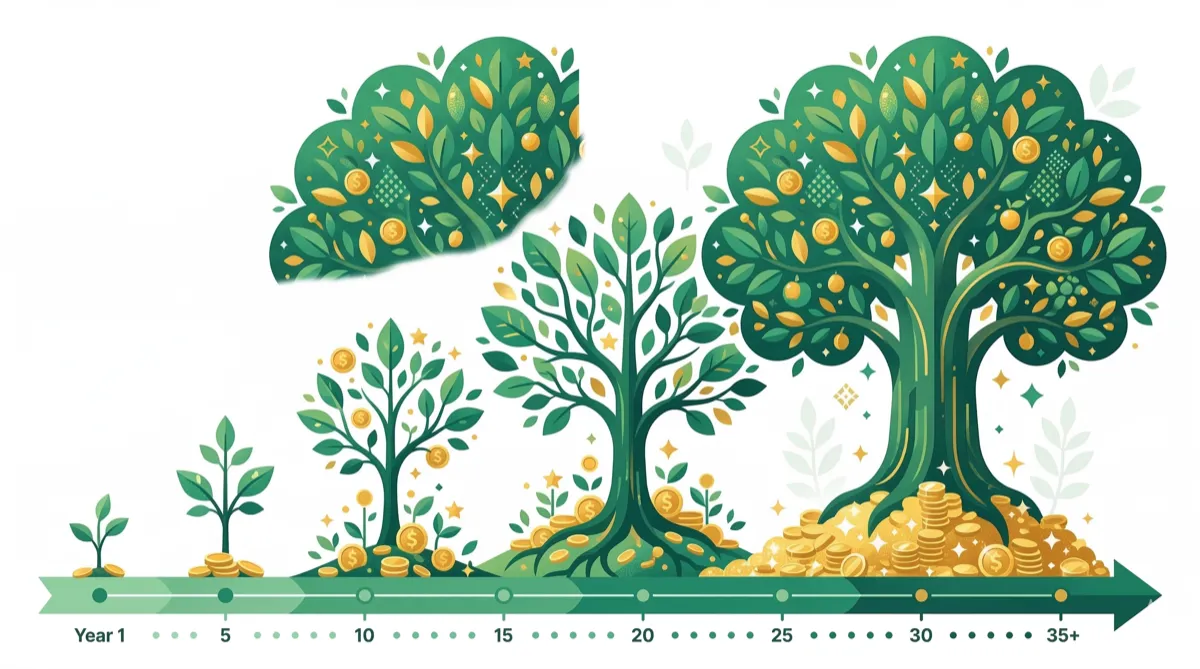
The math behind Coast FIRE is surprisingly straightforward. It boils down to two steps:
Step 1: Calculate Your Retirement Target
Using the widely-accepted 4% rule (from the Trinity Study), your retirement target is:
Retirement Target = Annual Retirement Expenses × 25
If you plan to spend $40,000/year in retirement, you need $1,000,000. If you plan to spend $60,000/year, you need $1,500,000.
Step 2: Discount It Back to Today
Your Coast FIRE number is your retirement target discounted back to today using the real (inflation-adjusted) rate of return:
Coast FIRE Number = Retirement Target ÷ (1 + Real Return)^(Years Until Retirement)
Where:
Real Return = (1 + Nominal Return) ÷ (1 + Inflation) − 1
For example, with 7% nominal returns and 3% inflation:
- Real return = (1.07) ÷ (1.03) − 1 = 3.88%
Full Worked Example
| Input | Value |
|---|---|
| Current age | 30 |
| Retirement age | 65 |
| Years until retirement | 35 |
| Annual retirement expenses | $40,000 |
| Retirement target (25×) | $1,000,000 |
| Nominal return | 7% |
| Inflation | 3% |
| Real return | 3.88% |
Coast FIRE Number = $1,000,000 ÷ (1.0388)^35 = $261,413
This means: if a 30-year-old has $261,413 invested today, compound growth alone will turn it into $1,000,000 (in today's dollars) by age 65. No additional savings required.
The Power of Time
Notice how sensitive the formula is to the years until retirement:
| Current Age | Years to Grow | Coast FIRE Number |
|---|---|---|
| 25 | 40 years | $216,245 |
| 30 | 35 years | $261,413 |
| 35 | 30 years | $316,017 |
| 40 | 25 years | $382,009 |
| 45 | 20 years | $461,758 |
A 25-year-old needs $145,000 less than a 40-year-old for the same retirement. That's the power of compound growth — and why starting early matters so much.
Don't want to do the math by hand? Use our free calculator — it handles all the formulas automatically.
Who is Coast FIRE For?

Coast FIRE resonates with a surprisingly wide audience:
Burned-Out Professionals
You've been grinding in a high-stress career for years. Coast FIRE gives you permission to downshift — take a pay cut, switch industries, or go part-time — without jeopardizing your retirement. The pressure of "I have to stay in this job because I need to save for retirement" evaporates.
Young Savers Who Started Early
If you started investing at 22 and lived below your means, you may already be closer to Coast FIRE than you think. Many diligent savers in their late 20s or early 30s discover they've already crossed the line — or are just a year or two away.
Parents Who Want Flexibility
Raising children often means wanting to work less. Coast FIRE lets you reduce hours or switch to a more family-friendly role without the retirement anxiety. Your investments are already on track.
Career Changers
Want to leave finance for teaching? Corporate law for nonprofit work? Coast FIRE means your retirement is secure regardless of your salary going forward. Pursue meaning over money.
Anyone Who Finds Traditional FIRE Overwhelming
Saving $1.5 million or more feels impossible for many people. Coast FIRE's lower target ($200K–$400K) is achievable for far more people, on far more income levels.
The Psychology Behind Coast FIRE
Traditional FIRE can feel unattainable — saving 50–70% of your income for 10+ years is extreme. Coast FIRE offers a psychologically powerful middle ground that shouldn't be underestimated:
The "Retirement Anxiety" Relief
Once you know your retirement is mathematically handled, a weight lifts. Financial decisions become simpler. Career choices become clearer. You stop optimizing every dollar for the future and start living more intentionally today.
The Identity Shift
Many people define themselves by their job because they have to work. Coast FIRE transforms work from obligation to choice. "I work because I want to" is a fundamentally different mindset than "I work because I have to."
The Permission to Slow Down
In a culture that glorifies hustle, Coast FIRE gives you mathematical permission to slow down. It's not laziness — it's strategy. You front-loaded the hard work. Now you're reaping the reward.
The Compounding Effect on Life Satisfaction
Studies consistently show that once basic needs are met, more money has diminishing returns on happiness. But more time, autonomy, and purpose have increasing returns. Coast FIRE optimizes for exactly those things.
Common Mistakes to Avoid
1. Ignoring Inflation
This is the #1 mistake. Many Coast FIRE calculators use nominal returns (7–10%) instead of real returns (3–5% after inflation). This makes your Coast FIRE number look artificially low and can leave you significantly short at retirement.
Always use inflation-adjusted calculations. Our calculator does this automatically.
2. Being Too Optimistic About Returns
Using 12% expected returns will dramatically underestimate what you need. While the S&P 500 has returned ~10% nominally over the long term, that includes periods of significant underperformance. Stick to historically grounded assumptions:
- Conservative: 5% nominal return, 4% inflation (1% real)
- Moderate: 7% nominal return, 3% inflation (3.88% real)
- Aggressive: 10% nominal return, 2% inflation (7.84% real)
3. Forgetting Healthcare Costs
In the US, leaving full-time employment means potentially losing employer-sponsored health insurance. Healthcare costs can be $500–$1,500+/month for a family on the ACA marketplace. Factor this into your annual expense calculations before declaring Coast FIRE victory.
4. Not Accounting for Lifestyle Changes
Your expenses at 65 may differ significantly from today:
- Lower: Mortgage may be paid off, no commuting costs, no work wardrobe
- Higher: Healthcare, travel, hobbies, possibly helping adult children
- Wildcards: Long-term care, inflation surprises, market downturns
Build in a reasonable buffer. Using a slightly higher retirement expense estimate gives you margin for error.
5. Treating Coast FIRE as a Guarantee
Markets don't deliver smooth 7% returns every year. They deliver +30% some years and −40% others. Coast FIRE is a planning framework based on historical averages, not a guarantee. Continue to monitor your progress and adjust if needed.
Coast FIRE vs. Other FIRE Strategies
Not sure Coast FIRE is right for you? Here's a quick comparison:
| Strategy | You Need | After Reaching It |
|---|---|---|
| Coast FIRE | $200K–$400K | Work for current expenses only |
| Barista FIRE | Varies | Part-time work + investment income |
| Lean FIRE | $750K–$1M | Full retirement, frugal lifestyle |
| Regular FIRE | $1.25M–$2M | Full retirement, comfortable lifestyle |
| Fat FIRE | $2.5M–$5M+ | Full retirement, luxury lifestyle |
For a deeper comparison, read our Complete FIRE Strategy Comparison.
Next Steps
Ready to take action? Here's your roadmap:
- Calculate your Coast FIRE number — Takes 30 seconds. See exactly where you stand.
- Find your monthly savings target — Learn how much to save each month to reach Coast FIRE by your target age.
- Explore Barista FIRE — See how part-time income could lower your target by 40% or more.
- Check Coast FIRE numbers by age — Find benchmarks for your age group.
- Compare all FIRE strategies — Figure out which approach fits your life.
Disclaimer: This content is for educational purposes only and does not constitute financial advice. Past market performance does not guarantee future results. Consider consulting with a qualified financial advisor for personalized guidance.